Planet RNG Constellations — Stars, Perks & the Cosmos Track
Collect stars, complete constellations, keep the perks forever. The panel reads like an endgame checklist with big percentage rewards.
Updated
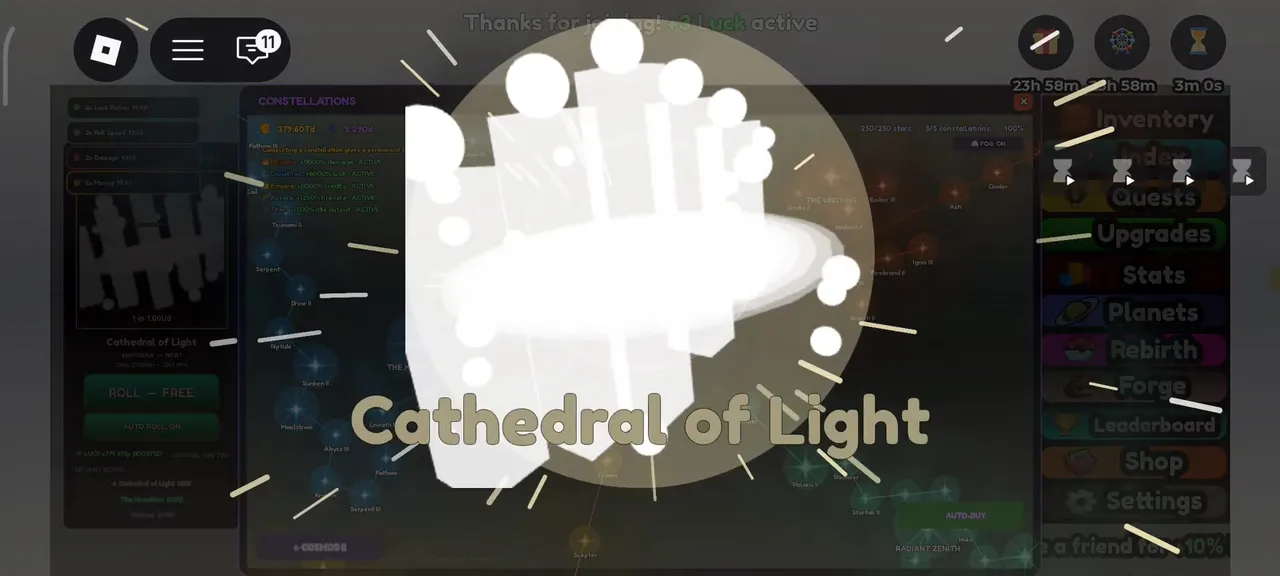
The Constellation panels mid-session: active perks on the left, the star track and next unlocks on the right.
What constellations are
The official description says it directly: 'collect stars from across constellations to upgrade your power'. In play, the Constellations panel is a two-column endgame track — completed constellations list their permanent perks on the left, while the right column shows the star count, the constellation tree and what completes next.
Active perks we filmed
A save with '5/5 constellations' and '250/250 stars' on the counter was showing these perks live, each with an ACTIVE tag. These are the only perk values we have read, and they are enormous by design — this is the layer that turns collection into raw output.
Constellation
Perk (as printed)
Fractalis
+9000% damage
Leviathan
+6000% luck
Empire
+6000% credits
Aurora
+1250% fire rate
Titan
+500% void output
The star track
The right panel carries the completion meter: '250/250 stars' in our read, with a '5/5 constellations' counter beside it and a percentage readout. Stars are collected from gameplay ('collect stars from across constellations' per the official text) and complete constellations once their quota is met — the panel text 'Completing a constellation gives a permanent…' was visible but cut off, matching the permanent-perk behaviour above.
The constellation tree
Below the counters sits a list of constellation and node names — THE UNDYING, Nimble II, Cinder, Bomber III, Ash, Firebrand II, Ignis III, Polaris II, Starfall II, Radiant Zenith, Halo on one side; Tsunami II, Serpent II, Dine II, Aptide, Sunken II, Maelstrom, Abyss III, Fathom, Serpent III on the other. The Roman numerals repeat here, so nodes come in tiers just like mutations. A 'FOG ON' toggle dims the backdrop for readability — a nice quality-of-life button worth knowing about on lower-end devices.
The Constellation tree column during a roll — node names, tier numerals and the AUTO-BUY button at the bottom.
COSMOS and AUTO-BUY
A '+ COSMOS II' control sits at the bottom of the left panel, and the tree has its own AUTO-BUY button — same pass-gating pattern as AUTO-BUY PLANETS, and the same store family of automation passes. What COSMOS unlocks beyond the visible tier, we have not seen activated; it is logged rather than guessed.
Priority in practice
With perks this large, the endgame priority writes itself: complete whatever constellation is closest to finishing, because each completion applies permanently to everything you will ever do afterwards. Leviathan's +6000% luck and Empire's +6000% credits overlap directly with the game's two currencies of progress, which is why constellation progress shows up in the same sessions as the biggest roll hits in our footage.
By playing — the official description says stars are collected 'from across constellations', and the panel treats them as a completion currency. We have not yet captured the exact drop moment on film, so the page notes the source without inventing rates.
What is the best constellation perk?
Of the five we have read: Leviathan (+6000% luck) if you are chasing rolls, Empire (+6000% credits) if you are pushing the planet ladder. Fractalis (+9000% damage) accelerates every destruction phase in between.
What does COSMOS do?
A '+ COSMOS II' button sits at the bottom of the constellation panel. It had not been filmed being pressed at the time of writing, so its exact effect stays open rather than guessed.