Does rebirthing reset progress in Planet RNG?
No. The panel prints 'All your weapons, upgrades & fleets are kept!' — the trade is credits for multipliers, nothing else.
Mid-game
Rebirth is a credit-for-multiplier trade with no downside except the wait. Here is how to tell when the wait has stopped being worth it.
Updated
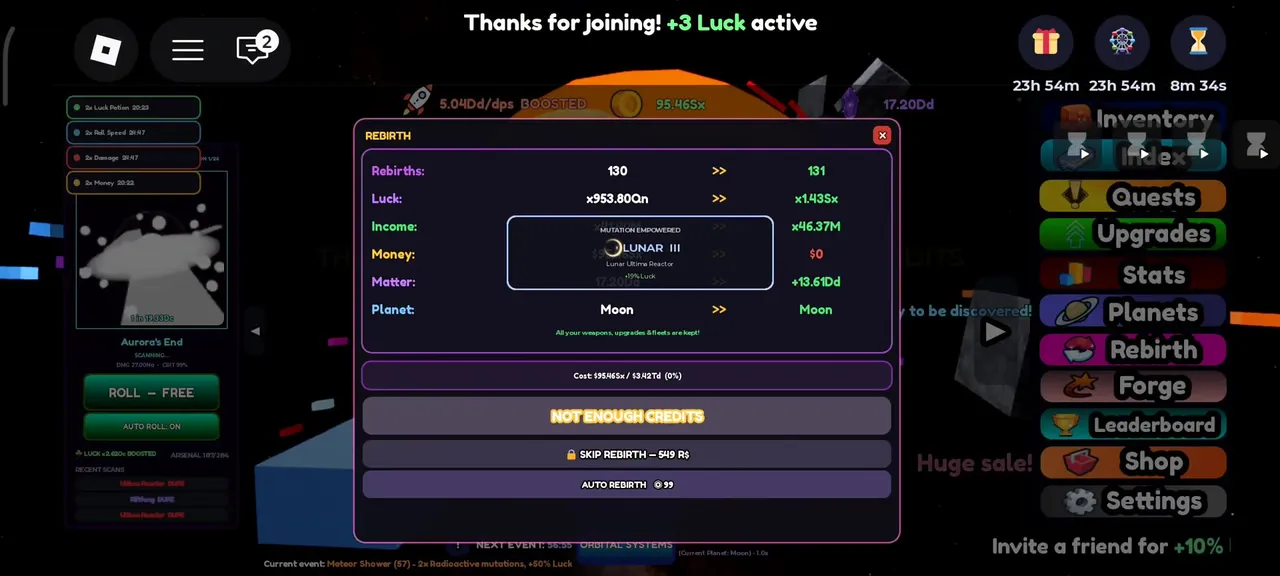
Rebirth spends credits and raises permanent multipliers. Since credits are the ladder currency and multipliers raise everything the ladder earns, the trade is almost always good — the interesting question is only when, and the panel answers it by printing both sides before you press anything.
Two filmed panels give the shape of late-game rebirths. Save A, at 128 rebirths: Luck x423.91Qn → x635.87Qn, Income x33.00M → x36.96M, cost $1.91Td. Save B, at 130: Luck x953.80Qn → x1.43Sx, Income → x46.37M, Matter → +13.61Dd, cost $9546Sx (or a discounted $342Td with progress). The one consistent pattern: every stat moves in the same direction, and the Luck line moves by the largest factor.
| Read | Rebirths | Luck | Income | Cost |
|---|---|---|---|---|
| Save A | 128 → 129 | x423.91Qn → x635.87Qn | x33.00M → x36.96M | $1.91Td |
| Save B | 130 → 131 | x953.80Qn → x1.43Sx | → x46.37M | $9546Sx / $342Td discounted |
The keep rule removes the classic rebirth dilemma: 'All your weapons, upgrades & fleets are kept!' means your Arsenal, your upgrades and your automation survive the press. The only thing rebirth costs is the credit price, and credits regenerate at a rate that itself grows with the multipliers you just bought. That is why the honest answer to 'when should I rebirth' is 'when you can afford it without stalling your next planet purchase for long'.
The main button prints its state. 'NOT ENOUGH CREDITS' means keep farming; a payable state means the game is inviting the press. Two adjacent controls deserve a mention: SKIP REBIRTH at 549 R$ buys the same rebirth for Robux — a pure convenience for people short on credits — and AUTO REBIRTH @ 99 automates the press entirely once you own the pass (store price: Auto Rebirth, 99 R$).
When both are affordable, planets edge it early (a purchase lasts forever and raises the rate you farm the next rebirth with), while rebirths edge it when a row is multiple sessions away — a rebirth's multipliers will accelerate the savings for that row. The practical tiebreaker: if the next planet is under an hour of farming, take the planet; if it is a multi-session wall, take the rebirth first and farm the row faster.
The site's rebirth planner on the calculator page takes your rebirth count and current planet row and returns the same rules of thumb this guide is built on. It cannot know your live costs — the panel does — but the priority logic transfers at any scale, and every figure feeding it is stamped with the date it was read.
FAQ
No. The panel prints 'All your weapons, upgrades & fleets are kept!' — the trade is credits for multipliers, nothing else.
Nothing changes in the shopping order: next planet row first, weapon rolling continues in the background, and bank a Luck Potion window for your next long session. The rebirth's value is the multiplier it just added to all of the above.
Only if the credit cost leaves you unable to buy the next planet afterward. Since multipliers accelerate farming, pressing a payable rebirth early is rarely a mistake — but the panel lets you check both sides before you commit, so use it.